When Is “Good Enough” Good Enough for AI in Developer Tools?
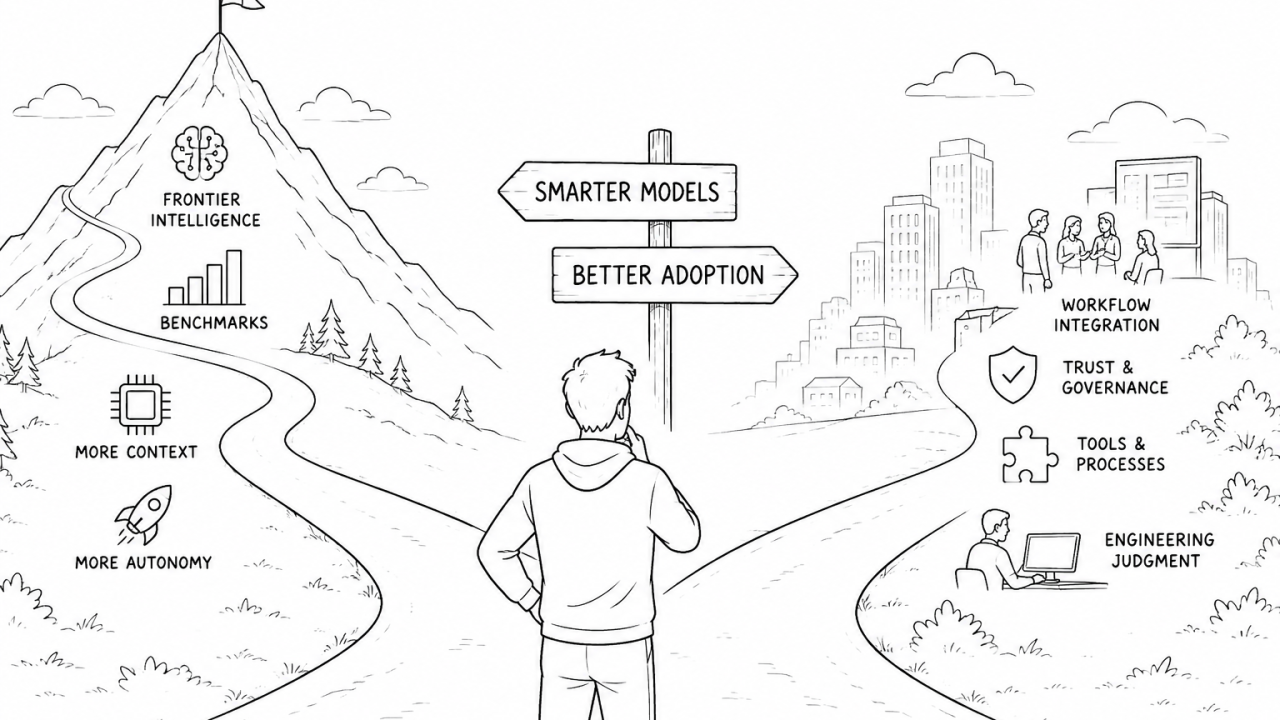
Anyone else suffering from new model fatigue?
Every week there’s another release. Better coding. Better reasoning. Bigger context windows. More autonomous agents. Another benchmark jump that’s supposed to change everything. And to be clear — some people absolutely need these improvements. There’s probably a real 90/10 rule emerging with AI models. The top 10% of engineering problems likely consume 90% of the value from frontier model improvements. If you’re working on distributed systems, compiler design, infrastructure at massive scale, low-level optimization, or genuinely novel engineering challenges, better models absolutely matter.
But most developers are not doing that work every day. Most are building business software. And for that world, I think AI crossed the most important threshold a while ago: useful enough to fundamentally change behavior.
Once these tools became capable of reliably helping with boilerplate, refactoring, test scaffolding, debugging, API usage, and framework navigation, developers naturally integrated them into their workflow. That shift was massive. The jump from “not useful” to “useful” changed software development. The jump from “useful” to “even smarter” feels very different. Smaller. More concentrated. And significantly more expensive.
I recently read a really interesting Substack article called “Claude Code is not making your product engineers 10x.” (https://ethanding.substack.com/p/claude-code-is-not-making-your-product?utm_source=tldrdevops) One observation in it stuck with me: senior engineers tend to use AI as acceleration, while junior engineers often use it as substitution.
That feels right.
Experienced engineers already understand tradeoffs, architecture, debugging patterns, operational concerns, and system behavior. AI removes friction and speeds them up. Junior engineers can sometimes use AI to compensate for missing experience instead of amplifying existing expertise. That doesn’t make AI bad, but it changes where the bottleneck is. It stops being purely about model intelligence and starts becoming about judgment.
At the same time, frontier models still carry materially higher costs than lighter-weight alternatives. Claude Opus pricing sits around $5 per million input tokens and $25 per million output tokens, while smaller models are dramatically cheaper. And the more capable the models become, the more organizations tend to expand usage until the savings disappear back into the workflow.
Meanwhile, most companies still haven’t solved the operational side of AI at all. Trust boundaries. Governance. Security. Workflow integration. PR review expectations. Hallucination handling. Knowing when AI output is “good enough” versus when deeper engineering review is required.
I’ve seen this before with enterprise software. Companies obsess over buying the absolute best platform while barely operationalizing the capabilities they already own. The organizations quietly winning are usually the ones integrating tooling pragmatically into real workflows instead of chasing theoretical maximum capability.
Which makes me wonder if the next phase of the AI race is less about building dramatically smarter models… and more about understanding where smarter models actually matter.
#AI #SoftwareEngineering #DeveloperTools #ArtificialIntelligence #Programming #TechLeadership #EnterpriseIT #ProductEngineering #LLM #EngineeringManagement