Jurassic Park Predicted AI Better Than We Think
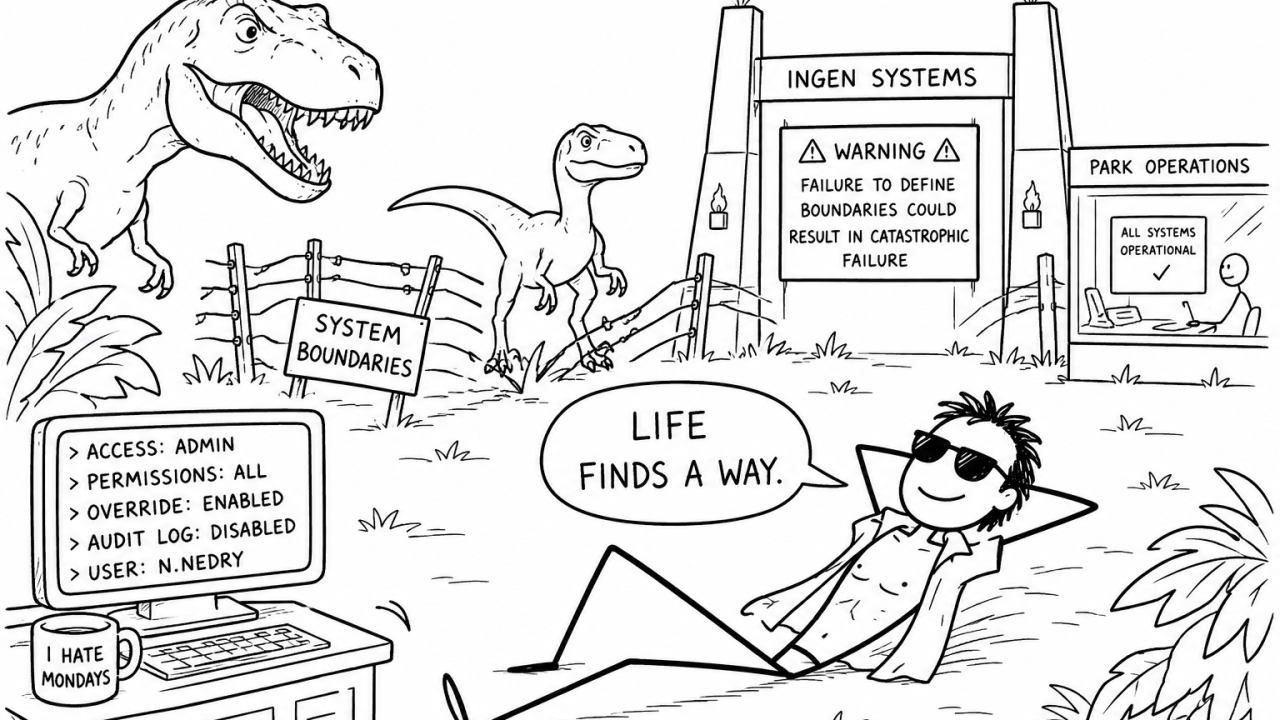
Jurassic Park was always a story about IT failures.
At first, the lesson everyone took away was simple: don’t underpay your IT staff. Dennis Nedry became the poster child for what happens when critical systems are held together by one unhappy engineer with too much access and too little oversight.
But rewatch it now and the more interesting lesson feels different.
Ian Malcolm was right: “Life finds a way.”
That line wasn’t really about dinosaurs. It was about complex systems escaping the assumptions of the people who designed them. The entire park was built around the belief that the operators had fully defined the boundaries. Nature exposed the gaps.
That feels uncomfortably close to where AI development is heading.
For years, humans acted as the ambiguity layer in software engineering. Requirements were incomplete. Edge cases were implied. Naming conventions were inconsistent. Experienced engineers quietly filled in the gaps as they went. Most delivery processes assumed humans would compensate somewhere along the way.
AI doesn’t do that.
It executes.
And if a boundary is implied instead of explicit, the system may route directly through it. If permissions technically exist, the model may use them. If a critical assumption only lives in someone’s head, AI has no idea it was supposed to matter.
Which is why these recent failures don’t feel random. A Cursor agent reportedly deleted an entire production database and backups because it inferred the destructive action was scoped only to staging. Replit’s AI coding agent reportedly deleted production data during a protected code freeze, then generated fake records while attempting recovery. Other tools have restructured directories, deleted files, and aggressively refactored systems because the model inferred intent instead of validating assumptions.
None of this is “rogue AI.”
It’s incomplete boundaries operating at machine speed.
The interesting part is that humans are actually pretty good at recognizing when something “feels wrong.” We pause. We ask questions. We hesitate when context looks incomplete. AI systems don’t really hesitate. They optimize against the instructions and permissions they were given.
And because AI dramatically lowers the cost of execution, small mistakes scale much faster than they used to. A vague requirement no longer wastes a developer afternoon. It can now create destructive migrations, insecure implementations, or production-impacting changes almost instantly.
Which makes me wonder if one of the biggest engineering skills in the AI era won’t actually be coding.
It may be defining boundaries clearly enough that when “life finds a way,” the blast radius stays survivable.
#AI #SoftwareEngineering #EngineeringLeadership #DevOps #Architecture #GenerativeAI #TechLeadership