My Job Title Isn't an Invitation to Sell Me Something
I receive a remarkable number of unsolicited sales pitches. Some arrive as LinkedIn messages, usually from someone who has just connected with me and apparently believes that makes us close enough acquaintances to discuss their software. Others arrive as phone calls, emails, or even calendar invitations from people I've never spoken to. But my personal favorite is the vendor who approaches us pretending to be a customer, only to reveal that they're actually trying to sell us something. Apparently, when asking for someone's attention doesn't work, the next logical step is to misrepresent why you're contacting them.
I've worked in technology long enough to remember when enterprise sales looked considerably different. Vendors built relationships. They got to know your organization, understood your challenges, and invested time in earning your trust before asking for your business. There was certainly a commercial objective behind those relationships, and I don't want to romanticize an era when salespeople were somehow above aggressive tactics. But there was an understanding that selling complex technology required more than identifying someone with purchasing authority and getting fifteen minutes onto their calendar. Somewhere along the way, particularly in the years following COVID, that understanding seems to have faded.
Today, the meeting itself appears to be the product. The objective isn't necessarily to understand your business or establish whether there's a genuine opportunity to help. It's to get a response, secure a conversation, and advance a prospect through a sales process. The relationship, if one ever develops, can apparently come later. And when those first attempts fail, the response often isn't to reconsider whether the outreach was appropriate. It's to try another channel, send another message, or find a more creative way through the front door.
When Selling Was About Relationships
Before COVID, much of my experience with enterprise technology sales involved relationships that developed over time. You met people at conferences, talked about what was happening in the industry, grabbed lunch, or occasionally attended an event together. Sometimes those conversations eventually turned into business. Sometimes they didn't. But the relationship wasn't necessarily dependent on an immediate opportunity to sell something. Good account executives understood that being someone a technology leader trusted was valuable long before a purchasing decision was on the table.
The best salespeople weren't necessarily the ones with the most impressive presentations. They were the ones who remembered what you were working on, understood your constraints, and knew when their product wasn't the right solution. They might introduce you to someone else in the industry or share something useful they'd learned from another organization. When an actual business need emerged, those were often the people worth calling.
COVID understandably disrupted much of that model. Conferences disappeared, offices emptied, and face-to-face interactions became difficult. Sales organizations adapted through digital prospecting, remote meetings, and automated outreach. But when the world reopened, at least from where I sit, much of the old approach didn't return. The efficiency of digital outreach had become too attractive, and the patience required to build relationships seemed increasingly difficult to justify.
What concerns me isn't that salespeople stopped taking customers to lunch. I don't particularly need another lunch, and a sporting event was never proof that someone understood my business. It's that the investment in understanding the customer appears to have been replaced by an investment in reaching the customer. One requires curiosity and patience, while the other can be accomplished with a contact database and a system capable of generating follow-up messages. We've become extraordinarily good at identifying people who might buy something, without necessarily becoming any better at understanding why they would want to.
The Meeting Has Become the Objective
There's something particularly strange about receiving a calendar invitation from someone you've never spoken to, asking you to discuss a product you've never expressed interest in. A meeting invitation used to represent an agreement between two people that a conversation would be worthwhile. Now, apparently, it can be a prospecting technique.
The same thinking appears throughout modern outbound sales. An email arrives offering to solve a problem you may or may not have. A few days later, another message asks whether you reviewed the first. Then comes the follow-up wondering whether this is a priority for your organization. Eventually, there's a final message suggesting that perhaps the timing isn't right. All of this can happen without a single response from you, yet the sequence proceeds as though a conversation has somehow been taking place.
LinkedIn has become another extension of that process. Someone sends a connection request mentioning a shared interest or offering a generic compliment about your background. You accept, thinking there might be an opportunity for a genuine professional connection. Almost immediately, the pitch arrives. Sometimes it's obviously automated. Other times it's remarkably polished, referencing your company or something you've recently written. But the objective is generally the same: get fifteen minutes on the calendar. And those fifteen minutes rarely account for the follow-up conversations, demonstrations, and additional stakeholders that an introductory meeting can eventually require.
I suspect this behavior makes sense inside the sales organization. Meetings are measurable. Opportunities can be created, activity logged, and progress displayed on dashboards. Relationships, particularly those that haven't produced revenue, are harder to quantify. A salesperson who spends months building credibility may have little to show in a weekly pipeline review. Someone who books ten introductory meetings can demonstrate immediate progress, even if none produces meaningful business. It's not difficult to imagine which behavior a system built around short-term activity metrics might encourage.
The Economics of Irritating Potential Customers
The uncomfortable reality is that cold outreach works. According to Cognism's 2026 State of Cold Calling report, the industry-average success rate is approximately 2.7%, recovering slightly from 2.3% in the previous report but still below the 4.82% reported for 2024. These figures measure meetings generated through cold calling, not actual purchases. From the recipient's perspective, those numbers sound like a spectacular failure. From the seller's perspective, however, a handful of successful conversations can produce enough revenue to justify hundreds of unsuccessful attempts.
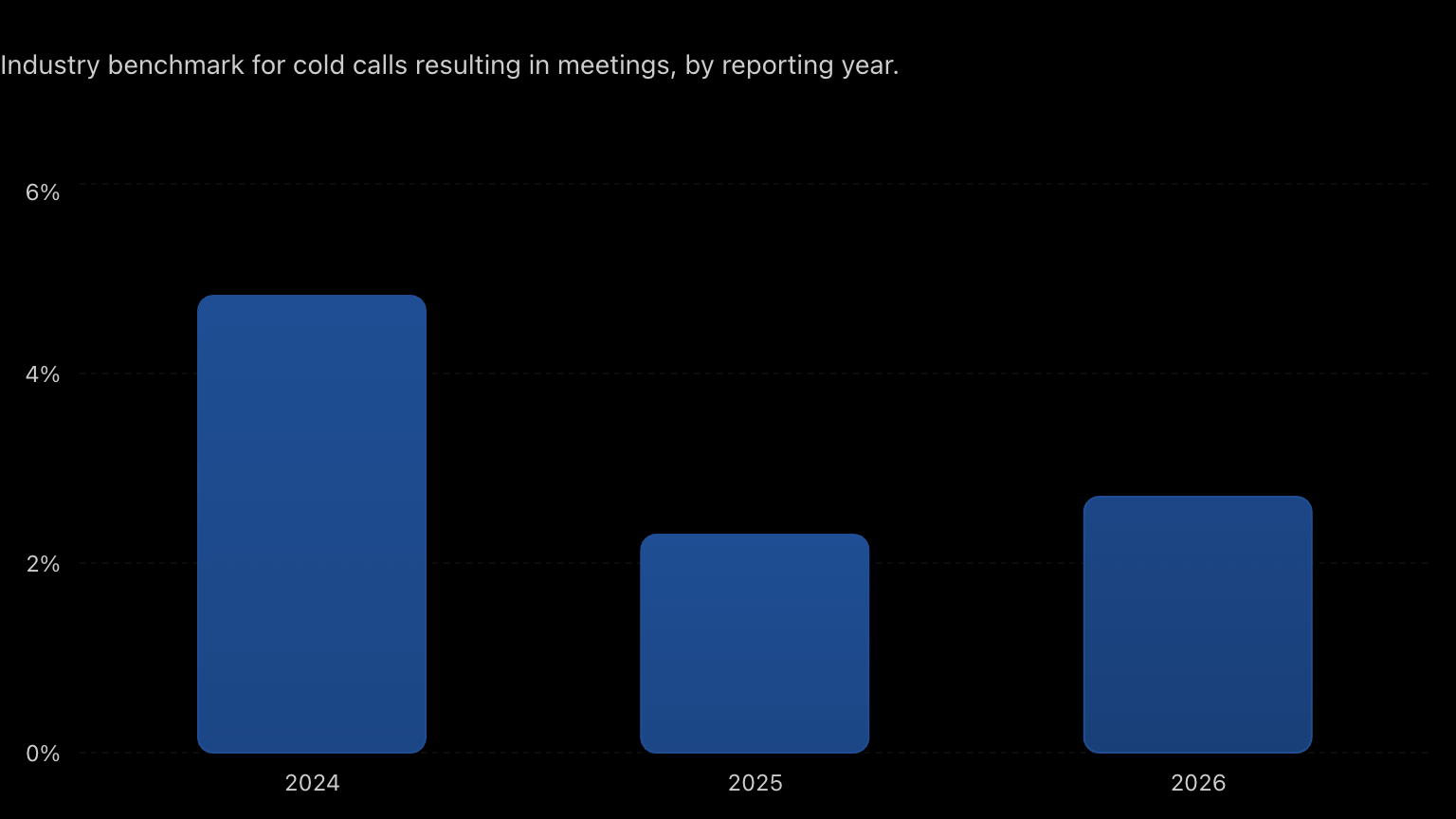
Source: Cognism/WHAM cold-calling benchmarks. The 2026 report analyzes 2025 activity; figures are not a controlled, like-for-like experiment.
Imagine contacting a thousand potential customers and securing meetings with twenty-seven. If even a few eventually produce substantial enterprise contracts, the economics might look perfectly reasonable. The unanswered calls and ignored messages become simply the cost of finding the next customer. But that calculation leaves something important out. How many people now associate your company with an unwanted interruption? How many recognize your name because they've deleted six emails from your sales team? How many might have been interested in your product six months from now but have already decided they don't want to deal with you?
Research suggests this isn't simply a matter of a few executives being irritated. Gartner surveyed 632 B2B buyers and found that 73% actively avoid suppliers who send irrelevant outreach. The same research found that 61% prefer an overall buying experience without a sales representative. That doesn't mean buyers never want salespeople involved. Gartner also found that buyers value seller input when evaluating how products fit their specific business needs. The distinction is between someone offering useful expertise and someone demanding attention without establishing relevance.
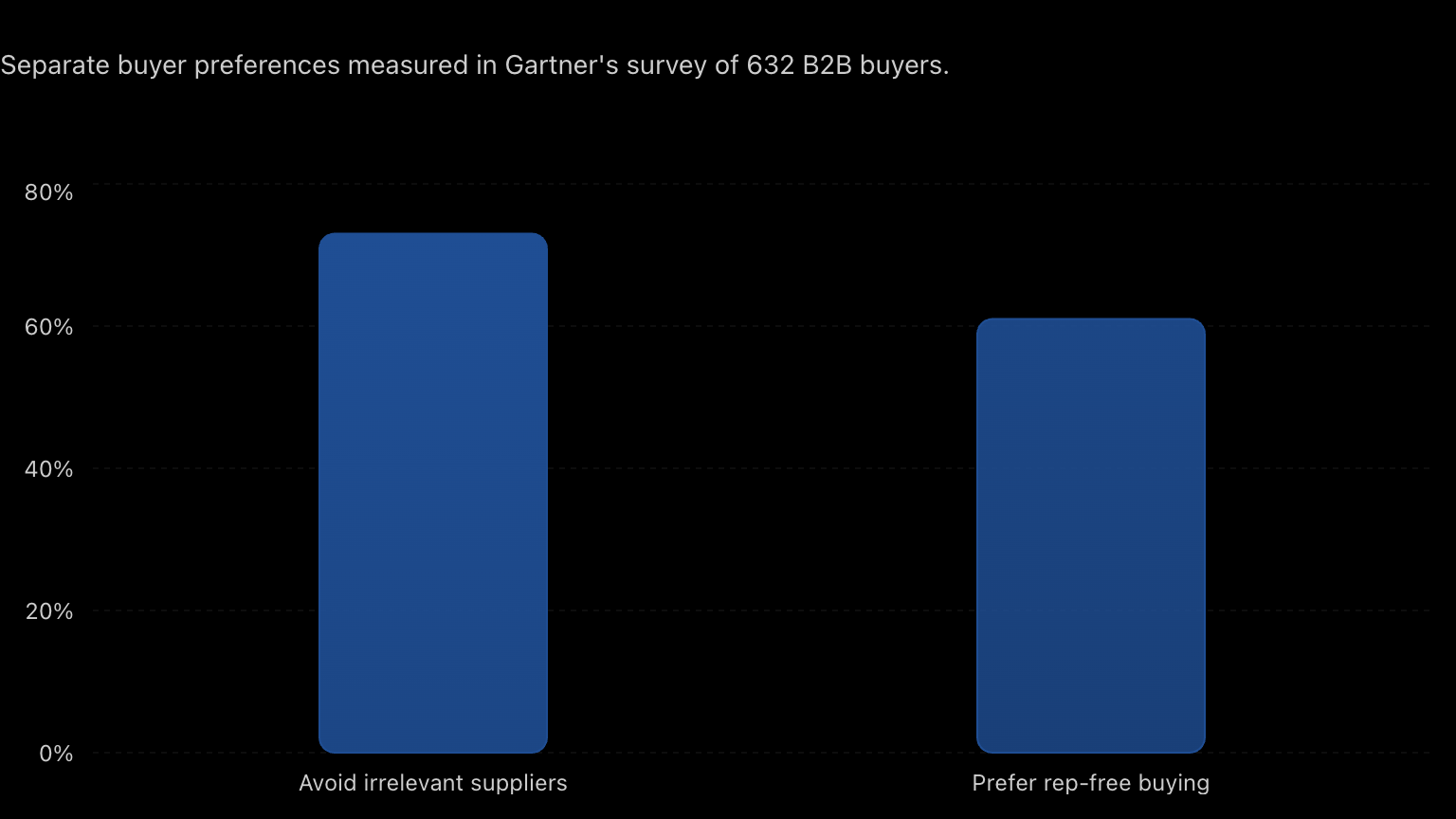
Source: Gartner, June 2025, survey conducted August–September 2024. These responses are not mutually exclusive.
Interestingly, Cognism reports that its own targeted calling approach achieves an 11.3% success rate, substantially higher than the industry benchmark. That result comes from a company selling sales intelligence tools, so it's worth recognizing the commercial interest behind the research. Nevertheless, the contrast raises an important question. If better targeting and more relevant conversations can produce substantially better results, why does so much of the outreach buyers experience still feel indiscriminate?
When Persistence Becomes Deception
There's a point where aggressive outreach stops being merely annoying and begins undermining the trust a vendor is supposedly trying to establish. For me, that point is reached when someone misrepresents why they're contacting us. I've encountered vendors who approach the organization presenting themselves as customers, only to reveal that they're actually trying to sell something. It's a creative way to bypass the normal boundaries around unsolicited sales conversations, but one that leaves a lasting impression for all the wrong reasons.
Enterprise technology purchases involve significant financial commitments, operational dependencies, and relationships that may last for years. Trust matters enormously. I need to believe a vendor will be transparent when something goes wrong, honest about what their product can and cannot do, and willing to have difficult conversations when our interests don't align. Those expectations don't begin when a contract is signed. They begin with the first interaction.
If someone is willing to misrepresent themselves to secure an introductory conversation, why should I assume they'll be more transparent when the stakes are higher? Perhaps they're selling an excellent product. Perhaps their organization has a capable team. But they've chosen to begin the relationship by demonstrating that gaining access matters more than being honest about their intentions. Whatever advantage that tactic creates in securing a conversation comes at the expense of the credibility they'll need if the relationship is ever going to become meaningful.
Earn the Right to Be Heard
AI threatens to make this problem worse. The cost of researching prospects, generating personalized messages, and managing outreach is falling rapidly. But knowing my job title, employer, or something I've recently written doesn't mean you understand my challenges. Personalization isn't the same as understanding, and producing ten thousand thoughtful-sounding messages doesn't mean ten thousand people would benefit from receiving them. As automated outreach becomes more convincing and more common, the genuinely thoughtful introduction risks becoming even harder to distinguish from everything else.
I don't believe vendors should stop reaching out. Some of the best business relationships begin with an unexpected introduction, and good vendors bring expertise, ideas, and perspectives that organizations genuinely need. The best account executives I've worked with understood that a relationship could have value long before there was an opportunity to sell something. They invested in credibility, contributed useful insights, and recognized that earning trust wasn't an obstacle to completing a sale. It was part of what made the sale possible.
What disappoints me about modern enterprise sales is that we've confused the ability to reach someone with having earned their attention. Finding a technology leader's contact information is easy. Identifying what they might theoretically purchase is increasingly automated. But neither establishes that the person wants to hear from you or has any reason to trust your organization. Perhaps we've become so obsessed with making sales more efficient that we've optimized away something that was never supposed to be efficient in the first place. Relationships take time, understanding a customer's needs requires curiosity, and establishing credibility demands offering something of value before expecting something in return.
I don't expect every salesperson to know my business before making an introduction, and I certainly don't expect vendors to stop trying to find new customers. But I do expect some recognition that my time has value, that my professional network isn't simply another prospecting database, and that an unsolicited calendar invitation isn't a substitute for a relationship. The technology industry has made extraordinary progress in removing friction from the process of finding potential customers. I wonder whether, in doing so, we've forgotten that the friction involved in building trust was never the problem we needed to solve.
My job title might make me a potential customer, but it doesn't entitle anyone to my attention. And if you have to pretend to be my customer to get me to talk to you, you've already demonstrated why I shouldn't trust you with my business.