AI Is Going to Kill Scrum — And Honestly, Scrum Had This Coming
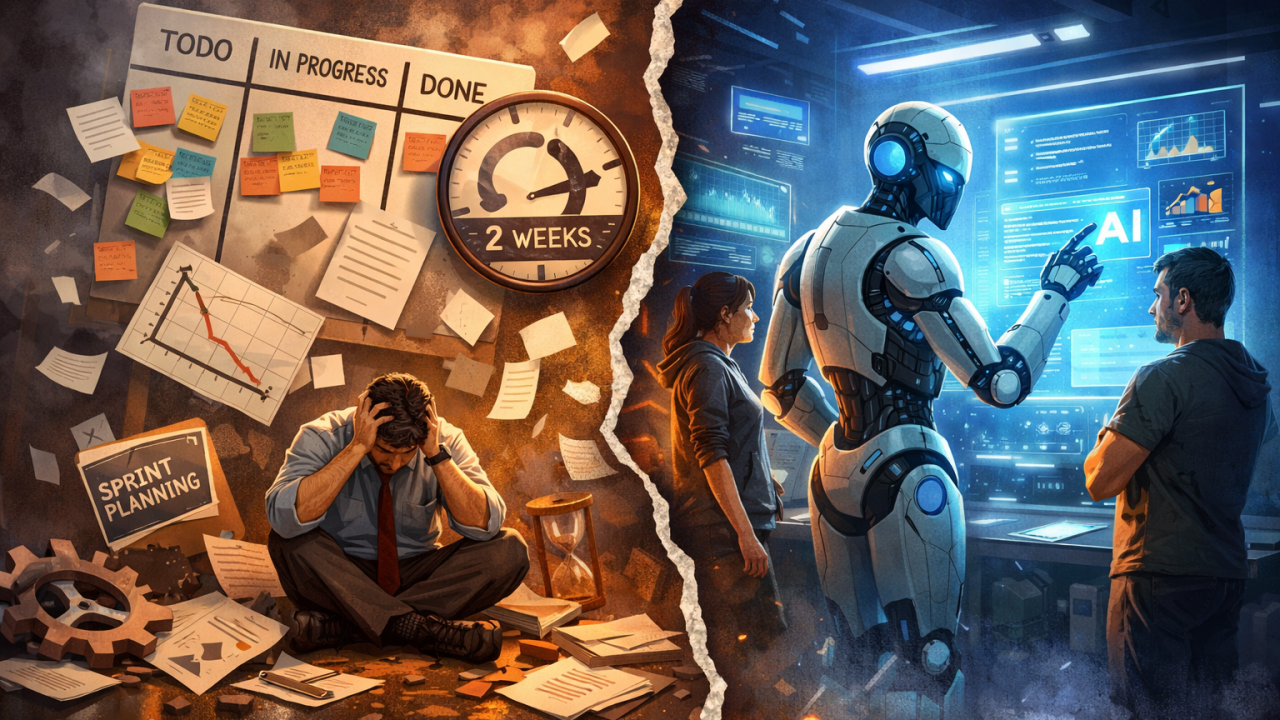
I’ve had an issue with Scrum for a while now. Not the idea behind it — breaking work into smaller pieces, getting feedback quickly, aligning teams — all of that makes sense. But the rigidity has always felt off. Too structured, too prescriptive, too confident that work can be neatly packaged into ceremonies and time boxes.
To be fair, Scrum does work — but in a very specific kind of environment. If you have a clean, greenfield problem, a focused team, and minimal interruptions, Scrum can run smoothly. The cadence holds, the planning works, and the team can actually commit and deliver. The problem is that most real environments don’t look like that. They’re messy. Priorities shift, stakeholders interrupt, and new information shows up mid-sprint that actually matters.
That’s where Scrum starts to feel frustratingly rigid. It’s kind of all or nothing. You either protect the sprint at all costs, or you constantly break it and end up pretending you’re doing Scrum while quietly ignoring half the rules. That tension has always existed — AI just makes it impossible to ignore.
Scrum was built for a world where development was slow and constrained by human effort. Planning, estimating, and batching work into sprints made sense when execution was the bottleneck. But AI flips that. Now building something — even something meaningful — can happen in minutes. The bottleneck isn’t coding anymore, it’s deciding what to build.
That shift exposes Scrum’s rigidity in a way that didn’t matter as much before. AI works in continuous loops: try something, evaluate it, adjust, and try again immediately. Scrum, on the other hand, forces work into fixed cycles. When you try to combine the two, the mismatch becomes obvious. Either you slow down to fit the sprint, or the sprint becomes irrelevant.
That’s when the ceremonies start to feel like theater. Standups become outdated status checks, sprint planning becomes guesswork, and retrospectives focus on metrics that don’t reflect how work is actually getting done. What used to create alignment starts to create drag.
This is why I don’t think AI just “changes” Scrum — I think it exposes its biggest weakness. The rigidity that always felt slightly off is now directly in conflict with how modern development works. AI didn’t create that problem, but it removes the buffer that used to hide it.
Scrum isn’t dying because AI is powerful. It’s dying because it doesn’t bend. And in a world where development is continuous, fast, and unpredictable, that kind of rigidity doesn’t just slow you down — it breaks the system entirely.